PRACTICE GUIDE / 杖道
WHAT IS
JODO?
A wooden staff. A wooden sword.
A practice built between two people.
Jodo (jōdō) is a Japanese martial art in which a practitioner uses a jo—a wooden staff—against a partner with a wooden sword. Training centers on kata: prescribed encounters that teach handling, distance, and timing.
This guide focuses on ZNKR Jodo, the standardized practice taught through KEIKO, and explains its relationship to the older Shinto Muso-ryu tradition.
STEP INTO PRACTICE ↓01 / ON THE PRACTICE FLOOR
What does training look like?
Start with the tools.
The standard jo is approximately 128 cm long and 2.4 cm in diameter. Its partner is a bokuto, a wooden sword. The staff has no blade, but neither tool is harmless: controlled movement and instruction matter from the beginning.
Learn a movement, then meet a partner.
Beginners work on handling, posture, footwork, strikes, and thrusts. Basic movements can be practiced alone, then with a partner. The sword side gives the action a distance and a direction; the jo side learns to respond within that encounter.
A kata gives both people a known sequence. Knowing what comes next does not remove the work. A step can leave too much space, a strike can arrive too early, or the hands can move without the body supporting them. Repetition gives a teacher something specific to correct.
The sword side is part of the lesson.
At KEIKO, learning both roles helps students understand what their partner is doing. Training is not simply a solo staff routine with someone standing nearby. Nor is it free sparring: the prescribed form lets the pair work on an encounter with control.
No previous martial-arts experience is required. Ask about suitable equipment before buying it; a guide cannot replace supervised practice.
02 / THE FOUNDING LEGEND
The Founding Legend
of Shinto Muso-ryu
Gonnosuke and Musashi. Defeat, retreat, revelation, and a return.
All four panels retell a traditional story—not a verified sequence of historical events. AI-assisted scenes are imagined illustrations, not portraits or technical demonstrations. Read in numbered order.
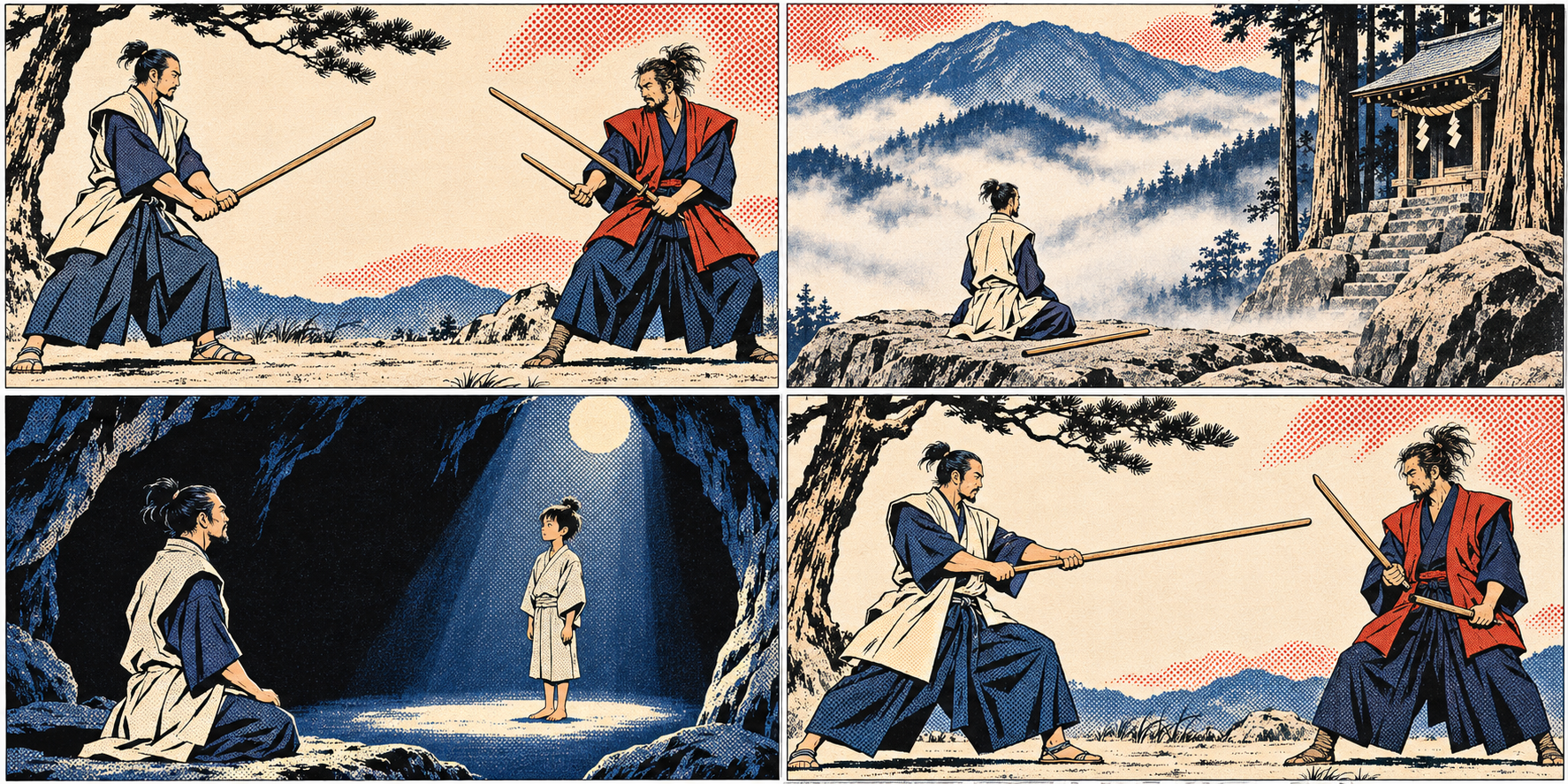
01 / THE FIRST ENCOUNTER
Stopped at the crossing.
The story begins with Muso Gonnosuke challenging Miyamoto Musashi. Musashi catches his wooden sword with crossed long and short wooden swords. Defeated but spared, Gonnosuke leaves with a problem he cannot put down.
02 / MOUNT HOMAN
Into the mountain.
His search leads to Mount Homan in Chikuzen, in present-day Fukuoka. In the traditional account, he withdraws to the mountain shrine for a period of prayer and training.
03 / THE REVELATION
A message in a dream.
A child appears in a dream or vision with the teaching: “With a round stick, know the suigetsu.” The story connects this revelation with Gonnosuke’s development of a shorter staff and a new approach.
丸木を以って、水月を知れ
04 / THE SECOND ENCOUNTER
The answer is a jo.
Gonnosuke returns to face Musashi with the jo. In the school’s familiar retelling, he overcomes the crossed-sword defense and wins the rematch.
03 / SIMILAR TOOLS, DIFFERENT PRACTICES
“Staff practice” is not one art.
ZNKR Jodo and Shinto Muso-ryu are related, not identical.
ZNKR Jodo offers a shared syllabus. Shinto Muso-ryu is a classical tradition with its own curriculum and lines of teaching. Studying the standardized forms does not, by itself, amount to studying the full classical school.
A jo does not make every practice Jodo.
You may also encounter a jo in aikido, or longer staffs in other arts. Shared equipment does not imply shared forms, body mechanics, or teaching methods. Ask which tradition a class follows rather than judging it by the weapon alone.
Kata is not the same as a demonstration.
A demonstration shows a form to an audience. In training, that form is also a way to examine a problem with a partner. The order may stay the same while the quality of the distance, timing, and movement changes.
04 / JODO IN THE SAN FRANCISCO BAY AREA
Learn with Chris.
Keep asking why.
Chris Yao holds 3rd dan in Jodo and teaches ZNKR Jodo through KEIKO. He also studies Shinto Muso-ryu as part of his continuing classical practice. These are related experiences, but the teaching offered here is described specifically as ZNKR Jodo.
Beginners are welcome. The emphasis is on sustained practice and understanding why an action works—not just remembering its outline.
The separate invitations for Hozoin-ryu sojutsu and IDO Daqiang are interest lists for developing practice groups, not existing Jodo classes or a combined curriculum.
ASK ABOUT JODO →Contact Chris about current arrangements, location, equipment, and getting started. Read about his practice and affiliations →
FROM THE NOTES
Questions from actual practice.
NOTE
When a Staircase Becomes Jōdō
At a Montréal seminar with Ōtake Toshiyuki-sensei, a spiral staircase recalled the path of a sword—and a simple strike opened onto a much harder question.
READ NOTE → BUDŌ · TRADITIONS
A New Sword Primer for an Old Tradition
At Shinseikan, a newly organized sword primer showed how a classical curriculum can remain unchanged while the path into it is carefully redesigned.
READ NOTE →