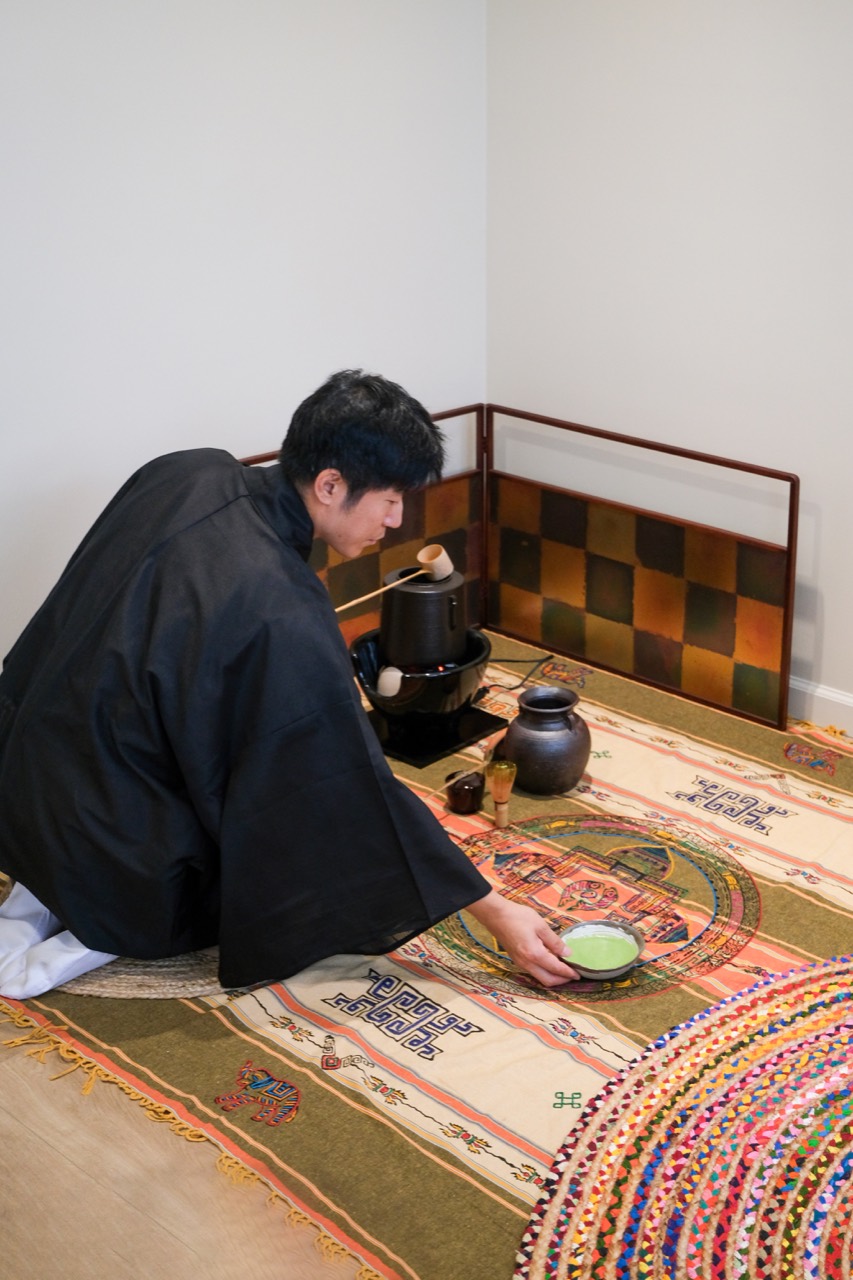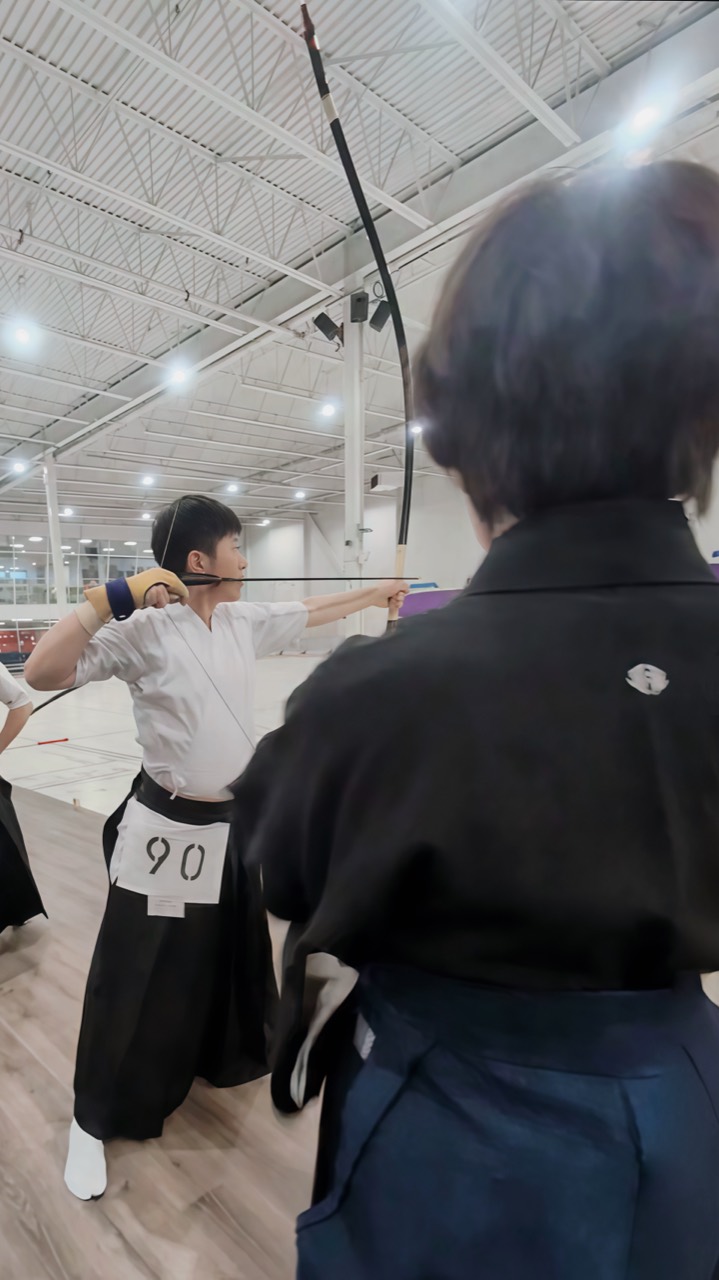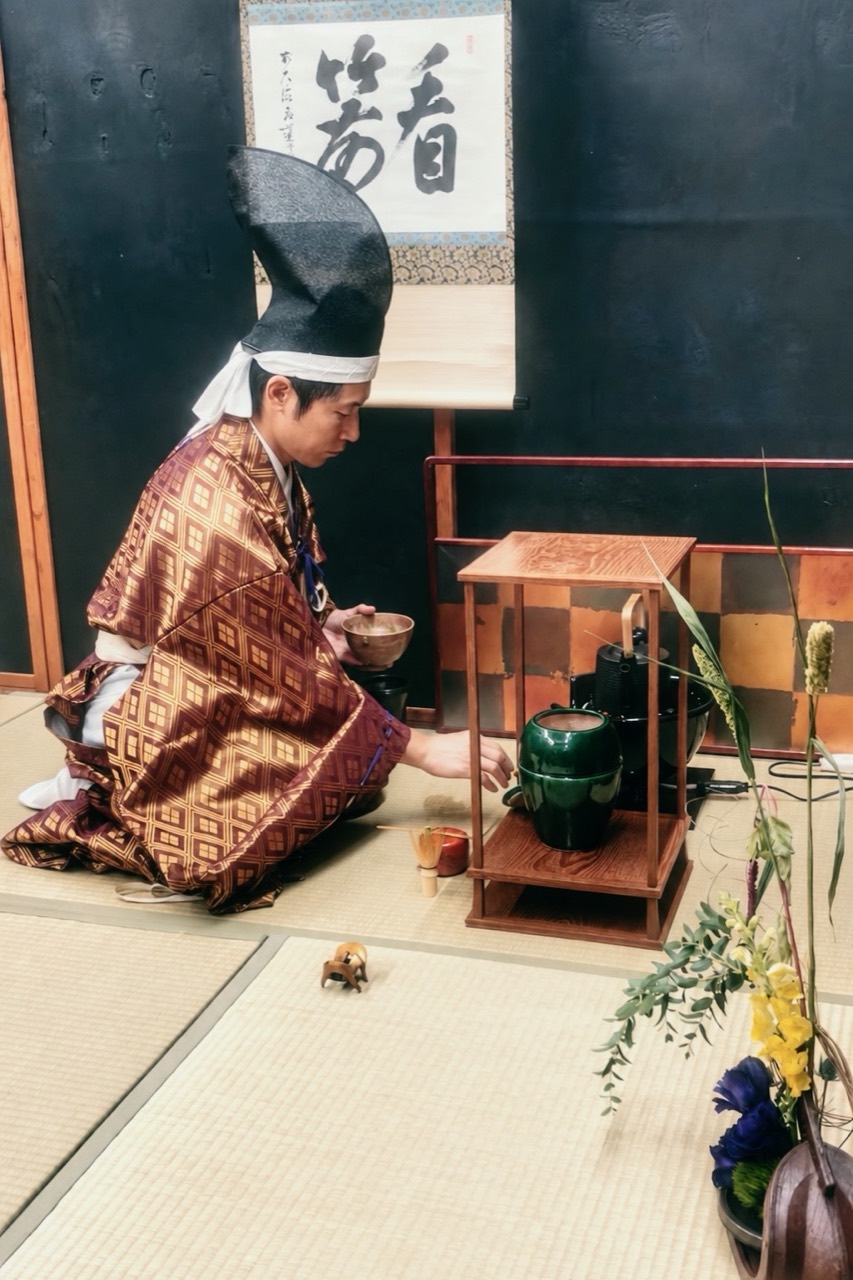
For this tea gathering, I put on a hiratare and eboshi: the formal robe and tall black headgear seemed appropriate for an afternoon devoted to yabusame, Japanese mounted archery. We were at Ogasawara-ryū America, just after the annual yabusame observance at Tsurugaoka Hachimangū in Kamakura. The setting had already done much of the work of choosing a theme.
I took the opportunity to bring out the tea utensils in my collection connected with bows and horses. The hanging scroll read 看箭—‘Watch the arrow.’ A Musashi stirrup served as the flower container. For the shelf, I chose a kuwa-kojoku, a small mulberry-wood stand whose association with an arrow stand was part of the story I had heard about it.
The water jar took up the theme of kaburaya, the whistling arrows used in ceremonial archery. The tea scoop bore the name 如矢, ‘Like an arrow,’ and a horseshoe served as the lid rest. The principal bowl was an Ido-style tea bowl decorated with targets and arrows. Some of these connections were visible in the objects; others lay in their names.
I also borrowed an adaptation of the first charcoal procedure that I had learned from another teacher. Since we were using an electric heater, there was no charcoal to lay. I performed only the incense portion of the procedure. That gave me a reason to use two more pieces: an incense container in the form of a Japanese saddle, and kettle rings with a bridle motif.
Bridle, saddle, stirrup, horseshoe. I was getting close to assembling a whole set of riding equipment in the tea room.
The combination also brought back a question I have been thinking about for some time: how have Urasenke tea practice and Ogasawara-ryū etiquette influenced one another? I have wondered whether particular procedures reflect historical borrowings. The details deserve a separate essay, with more careful attention to the evidence.
There are clearer personal connections. Hōunsai, Sen Genshitsu, Urasenke’s fifteenth-generation head, was deeply involved in equestrian life. He served as president of the Japan Equestrian Federation and chaired the organization supporting the preservation of yabusame at Shimogamo Shrine. Tea and mounted archery were not distant interests for him.
The guest had specifically asked to experience a tea gathering on a special day. That request mattered to the preparation. I wanted the choice of utensils, the setting, and even what I wore to answer the occasion.
A guest need not know every reference for those choices to have an effect. The stories can be discovered later. For now, the objects, the clothes, and the place had come together for this particular gathering. I hoped that, afterward, a bowl of matcha would bring back this day.