The guests came to tea with lacquer work still fresh in their attention. They had spent the first part of the afternoon joining fragments, applying urushi, and polishing repaired surfaces in a kintsugi class led by makomako of New York Kintsugi. Then, at Shanti-Dhara Wellness in Palo Alto, the object in their hands changed: from a vessel under repair to a tea bowl ready to be received.
I prepared the setting around two ideas—kintsugi and araijakin, the summer procedure in which the tea cloth is lifted from a shallow bowl of water. The connection did not need to be announced. Both concern what hands do with objects, and both make small changes to a surface unusually visible.
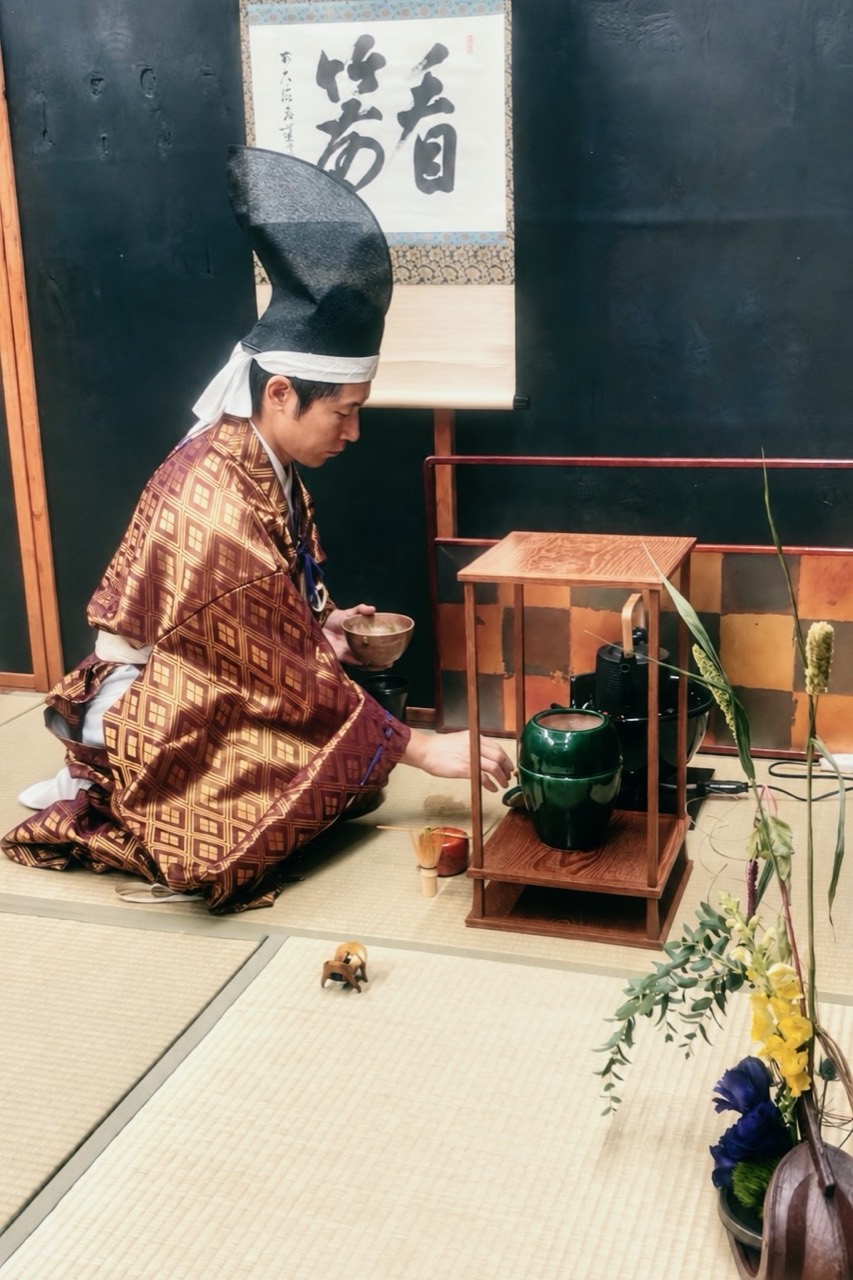
In the tokonoma, I hung an ensō inscribed *Mujinzō*, “Inexhaustible Treasure.” An ensō is not a standardized circle. The density of the ink, the speed of the brush, and the place where the line approaches its beginning remain visible. The circle carries the event of its making.
The flower container was a Katsura basket. The historical basket on which this form is based is traditionally associated with the Akō rōnin incident: damaged, repaired, and returned to use as a tea utensil. Its interest lies not simply in having survived. The repair became part of the object’s later identity without preventing it from continuing to serve.
The flowers came from closer by. Irises appear along the paths near my home at this time of year, so I brought in leaves and flowers I had been passing on ordinary walks. They connected the tea setting to the immediate season more directly than something chosen only for symbolic effect.
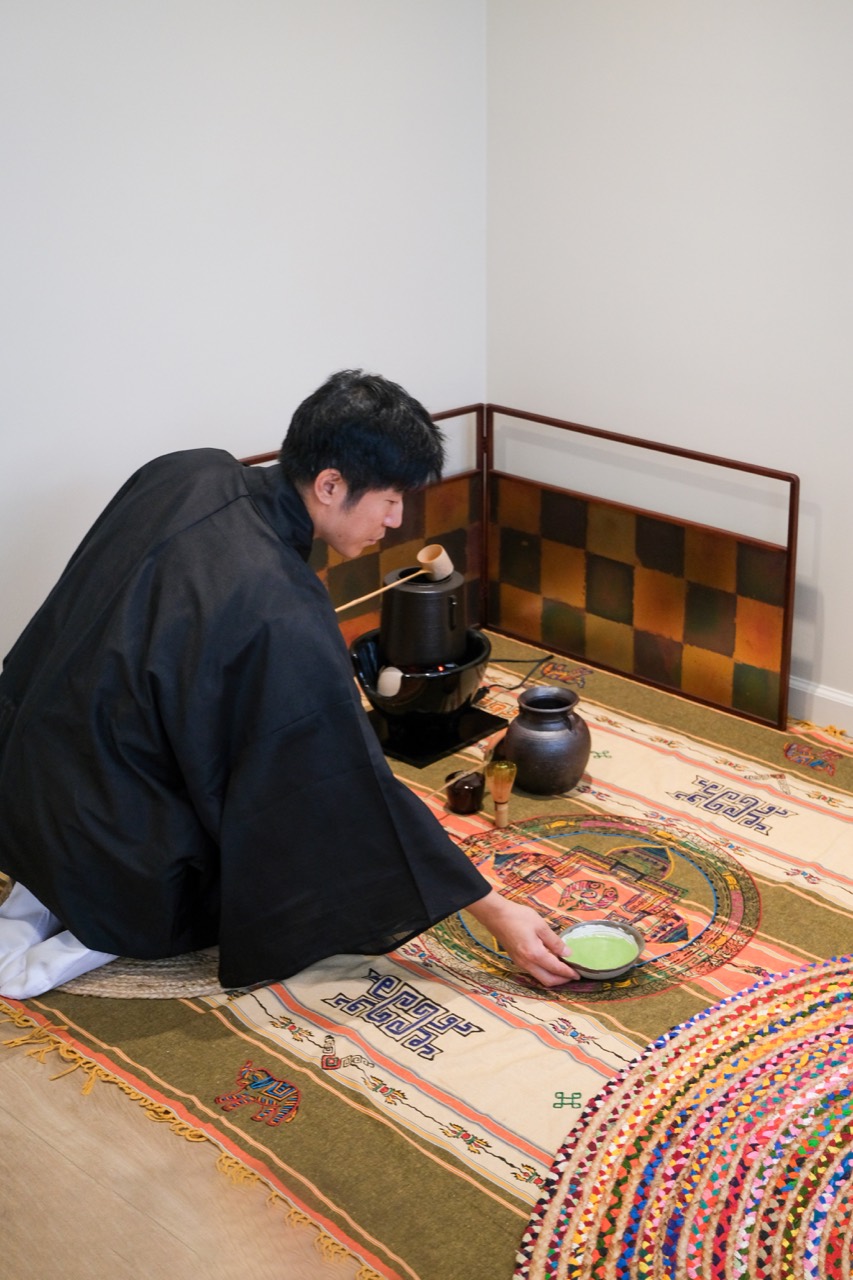
The gold-and-silver ichimatsu pattern of the furo-saki screen introduced a different geometry. Its alternating squares joined and continued across the surface, making connection itself part of the scenery.
Circles appeared elsewhere. During araijakin, drops fell from the chakin into the flat tea bowl; even when the ripples were difficult to see, the sound and movement suggested rings traveling outward. Shanti-Dhara’s floor covering carried concentric and mandala-like patterns, so I chose utensils that could answer it: a flat hakeme bowl, a spiral-patterned usuki, an itome kettle, a kuchi-itome kensui, and a sweet container with a spinning-top motif.
The room risked becoming visually busy. A small Nanban-style lug-handled jar served as the mizusashi. Its rough clay surface lowered the volume of the gold-and-silver screen and the richly patterned floor. Not every object needed to repeat the pattern; one needed to give the eye somewhere to stop.
Most of these utensils had never appeared together before. They were not assembled to illustrate a single theme perfectly. Some answered the guests, some the season, some the room, and one carried a story of damage and continued use. Their relationship existed only because these people entered this space on this afternoon.
After the kintsugi class, the students put down the objects they were still repairing and received a bowl of tea. *Ichigo ichie* is often translated as “one encounter, one time.” Here it felt less like a distant philosophy than a practical fact: this particular arrangement had never existed before, and once the bowls were cleared, it would not exist again.