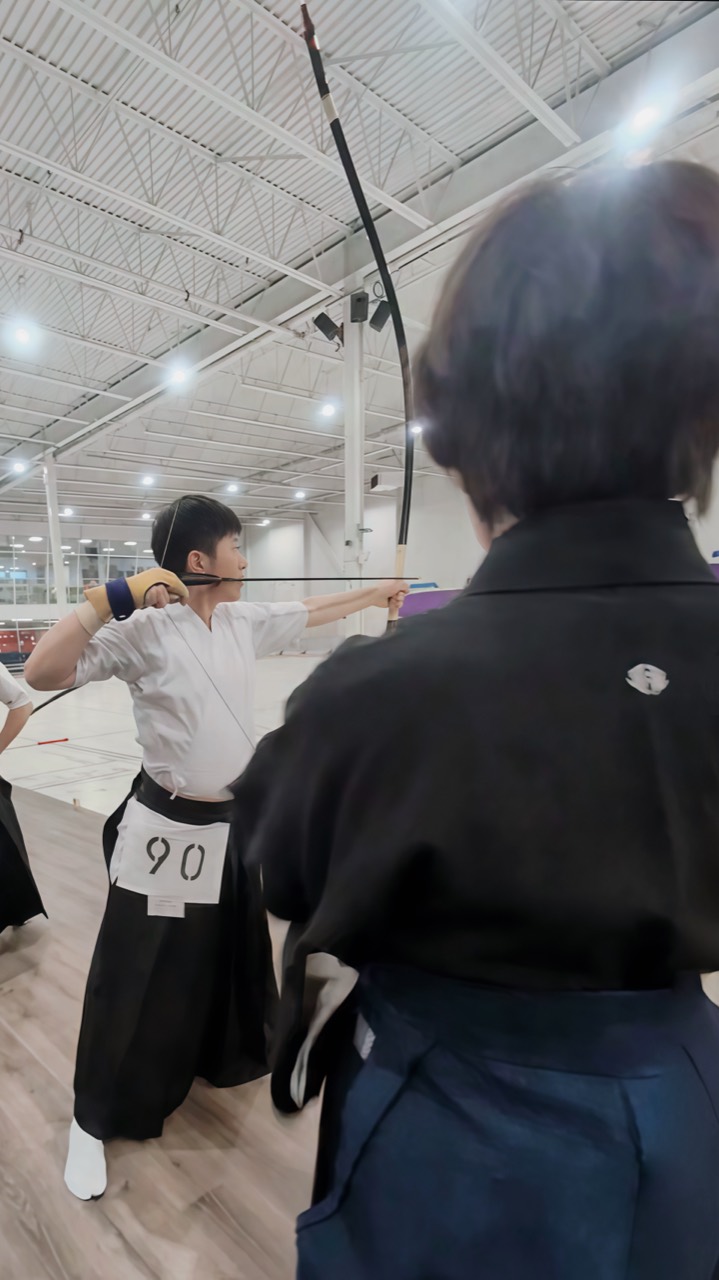
At the Vancouver kyūdō seminar, Usami Yoshimitsu-sensei—hanshi, ninth dan—gave North American practitioners a direct assessment. Our taihai, he said, was reasonably good. Our rate of hits was not.
Much of the seminar returned to two connected problems: tenouchi, the work of the bow hand, and awase-banare. Usami-sensei used the latter in a broad and uncompromising sense: any faulty hanare is awase-banare. By the time the arrow leaves, the conditions for that fault have already been built through the draw and kai.
To someone watching from outside, awase-banare is usually easy to see. The observer can compare both sides of the body and notice which one moves first, where the direction changes, or what suddenly loosens. The outward signs vary. The body may add a movement at the instant of release. The archer may adjust the aim during kai, soften the bow hand to encourage a handsome yugaeri, or open the string hand and let the string go.
The difficulty belongs more to the archer. From inside the shot, a familiar added action can feel normal, especially when it happens too quickly to register as a separate decision. That difference in viewpoint shaped the instruction. The teachers could point to a fault that was visible from a few feet away but almost absent from the archer’s own experience of the shot.
Tenouchi required the same close attention. Several eighth-dan hanshi stood near enough to see what was happening inside each person’s bow hand. Because no two hands are exactly alike, the corrections were equally specific: too much contact here, too little there, force traveling in the wrong direction, or an extra action appearing just as the arrow left.
A book can explain the principle of tenouchi. It cannot stand beside this particular hand and show where this particular habit begins.
That difference matters. General instruction gives the archer an idea to pursue; close correction gives the body a problem it can no longer ignore. Once an instructor identifies the small action that has been hiding inside the release, the next arrow feels less familiar. That discomfort is useful. It means the habit has become visible.
Usami-sensei’s comment about accuracy could easily be heard as a demand to aim harder. The seminar suggested almost the opposite. If the desire to hit makes the archer adjust, loosen, or choose the moment of release, accuracy begins to interfere with the shooting that should produce it. The work is not to make hanare happen more decisively. It is to keep developing kai—and become patient enough not to finish the shot by hand.

