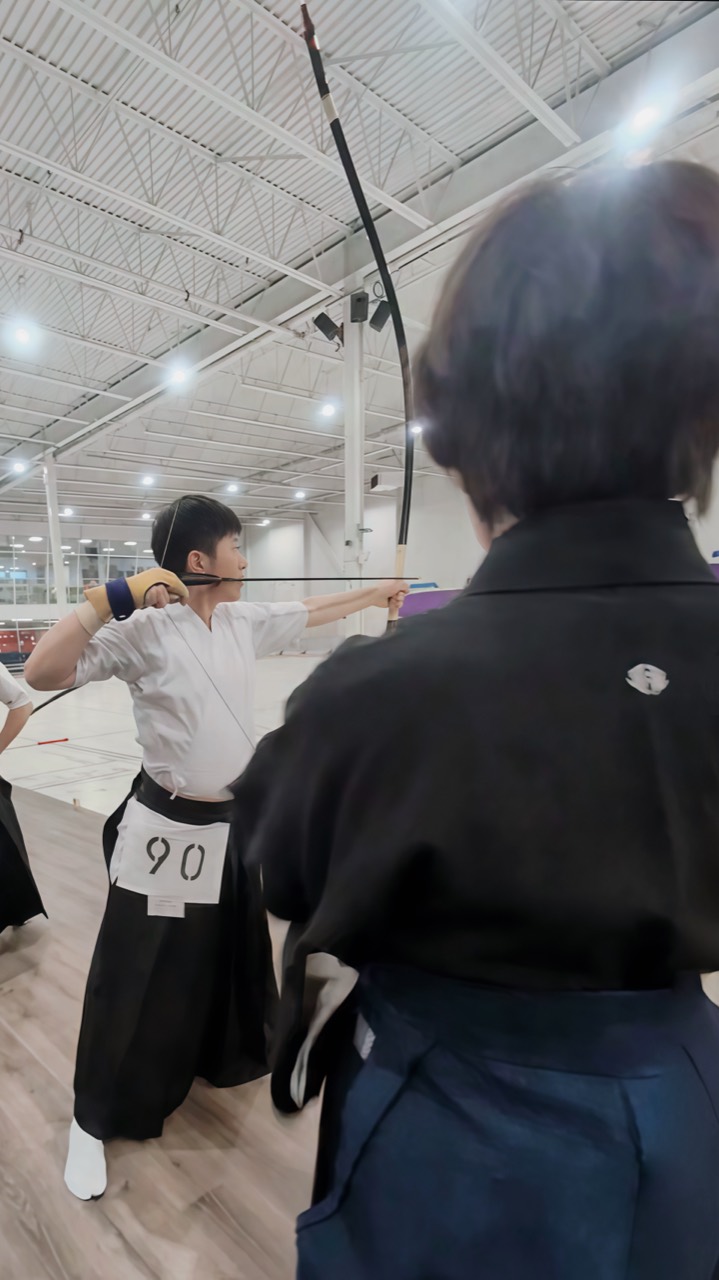
At the 2026 U.S. Naginata Championship in Torrance, I entered engi-kyōgi and team shiai. The two events use the same weapon and ask for almost opposite kinds of attention. In engi, my partner and I knew every movement in advance. In shiai, the person opposite me was working to make prediction unreliable.
Engi is not simply a test of whether two practitioners can remember the selected techniques. Distance, posture, accuracy, timing, and the relationship between partners have to arrive together. If one person rushes, the other has to choose between following the mistake and breaking the shared rhythm. If both become too careful, the exchange remains correct but loses pressure. The sequence is fixed; the coordination is not.
Team shiai changes the scale of time. Openings appear briefly and close as soon as they are recognized. An attack has to be committed enough to count, but the mind cannot stop at the strike. The opponent is still moving, and the individual match belongs to a larger team result. There is very little room to admire what just happened.
Competition compresses familiar practice. The court feels smaller, the pace feels faster, and techniques that seem available in regular training sometimes require an extra moment that the opponent does not provide. That is uncomfortable information, but it is precise. Pressure shows which parts of practice have become usable and which still depend on cooperation from the circumstances.
I did not win a medal. Even so, I felt that both performances represented my current practice honestly. In engi, there were exchanges in which the timing between partners stayed connected without becoming mechanical. In team shiai, there were moments when I recognized the distance, entered decisively, and continued rather than remaining mentally attached to the previous action.
Those moments do not cancel the result. A medal is a clear measure, and I would have been pleased to bring one home. But the result sheet records placement, not the exact point at which preparation held together—or the point at which it did not.
The useful questions became clearer afterward. Can the engi become more unified without losing attack? Can I create an opening in shiai rather than wait for one? Can technique remain decisive when fatigue begins to shorten attention? Torrance did not provide a medal as an answer. It provided better questions, which may be the more durable result.