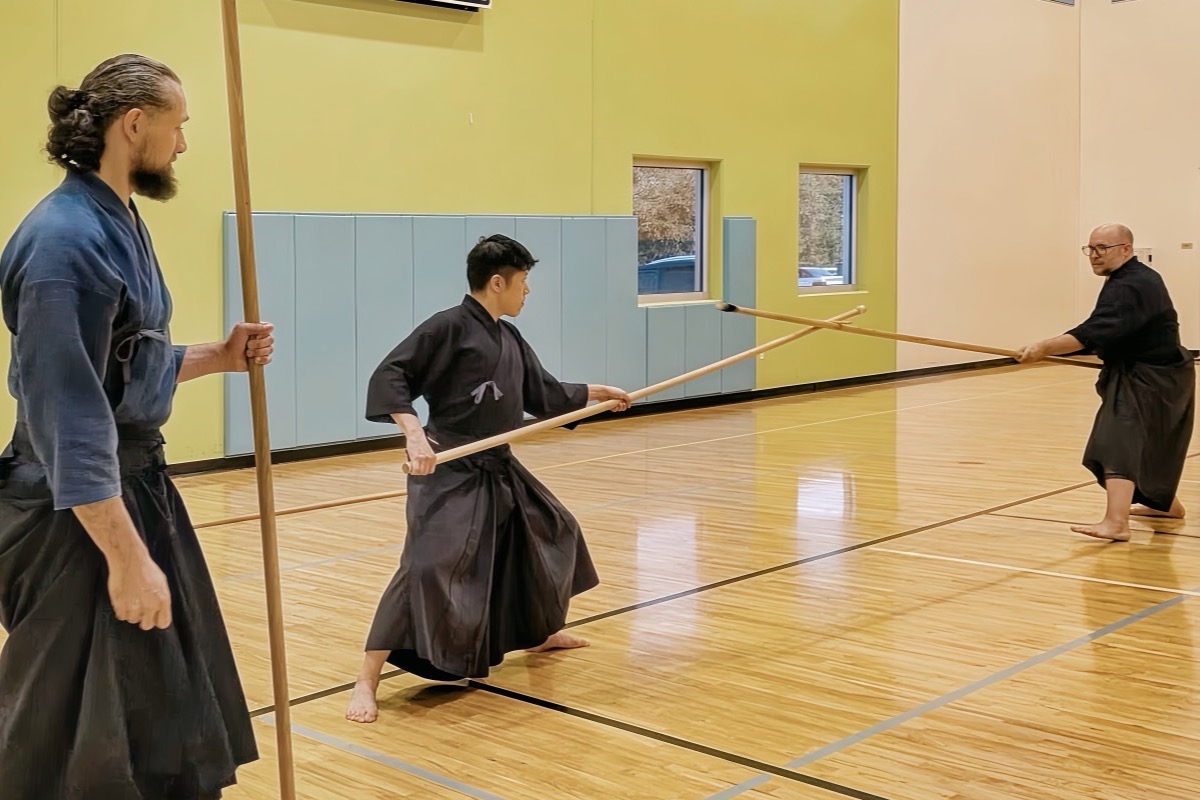
At my first Hōzōin-ryū sōjutsu gasshuku in Port Charlotte, the first surprise was the unequal reach. Uchiyari, the teaching side, held a straight spear. Shiyari, the learning side, held the tradition’s jūmonji kamayari, with two sickle-like blades extending from the central point. The more elaborate weapon was also noticeably shorter.
That difference changes the encounter. Shiyari cannot remain outside and win by reaching first. The side blades of the kamayari have to catch, press, guide, or displace the straight spear’s shaft. Once its line has been moved away from the center, the shorter weapon can enter.
The attacks themselves are plain. The point thrusts. Most of the technical interest lies in what happens to the other spear immediately before that thrust: hiki-otoshi, maki-otoshi, uchi-hari, and related actions that control the shaft long enough to create an opening.
With a long weapon, a small error at the hands becomes much larger at the far end. If the angle of control is slightly wrong, the straight spear does not remain displaced. It returns toward the center through an opening that feels surprisingly large. The technique may look almost correct near the body while failing completely at the point.
Several kata from the fourteen-form Omote set made the system’s range of problems clearer. In Makiyari, the straight spear rotates before the thrust. The action reminded me visually of circling movements found in some Chinese long-spear practice. The resemblance does not make the systems equivalent, but it made the incoming problem immediately legible: the weapon’s line is already moving before the thrust begins.
Kuda addresses a tube-guided spear and includes a large twisting action. The kata preserves an answer to a weapon whose mechanism changes the speed and manner of repeated thrusts. It is a useful reminder that an old form may be carrying a technical conversation with equipment no longer commonly seen in practice.
To a beginner, the jūmonji kamayari can feel almost unfair. Straight spear against straight spear produces a contest of line, leverage, and reach. Add the side blades and the longer weapon can suddenly be caught. But the apparent advantage does not remove the need for timing. It narrows it. Catch too early, too late, or at the wrong angle, and the straight spear remains dangerous.
I arrived with a simple picture of spear fighting: distance, forward movement, and repeated thrusts. Hōzōin-ryū replaced that picture with a more interesting one. The decisive moment often occurs before the thrust, when one weapon changes what the other is allowed to do. The cross-shaped head is visually distinctive. Its real advantage is that it turns reach into something that can be controlled.